

By: Stephen Chacon
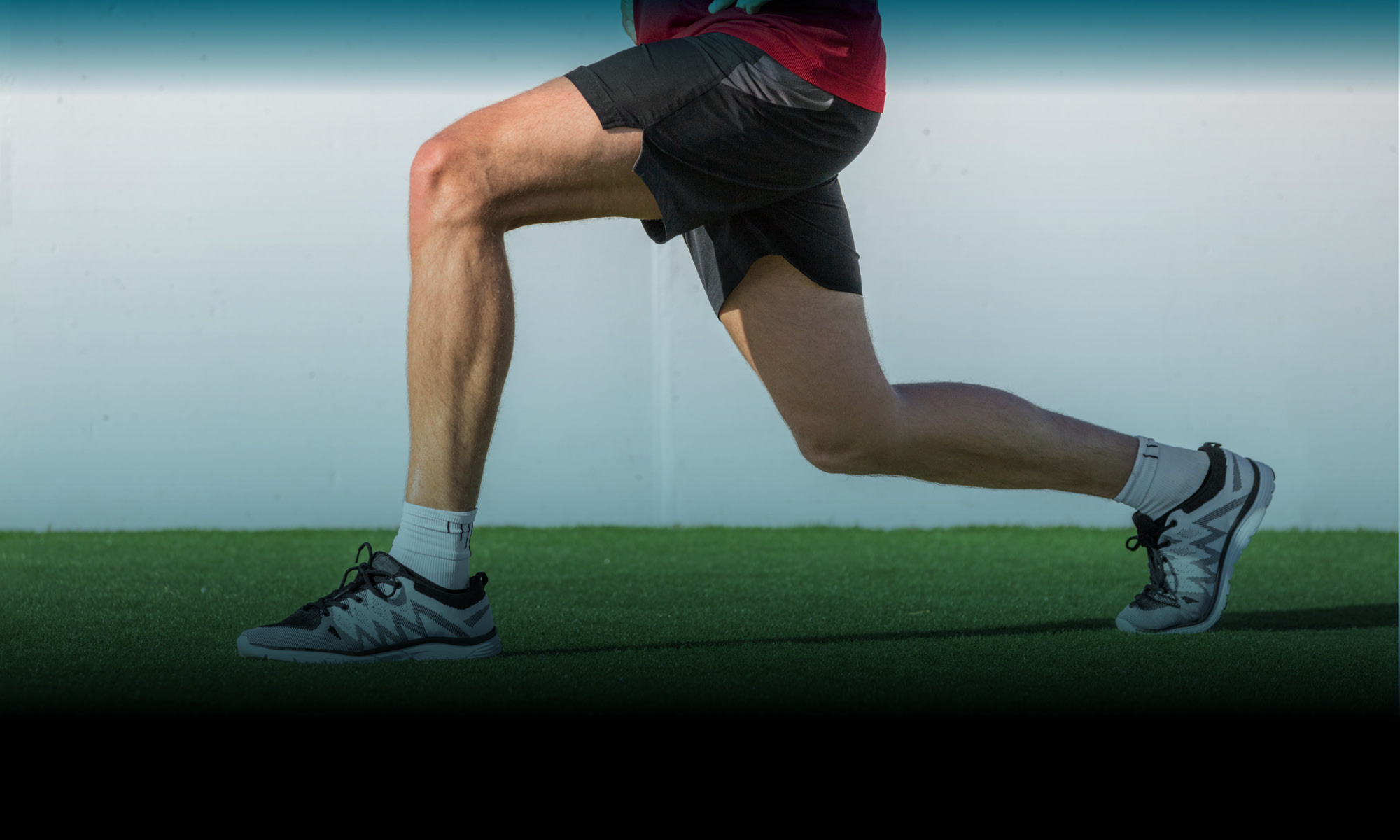
Glute training is one of the most important components of a well-structured exercise plan, and the reasons extend far beyond working towards a specific shape or look. The muscles that comprise your glutes (gluteus maximus, medius, and minimus) are essential for supporting good posture, reducing or eliminating lower back pain, improving balance, and reducing your risks for a wide range of injuries. And yes, a powerful backside can also help you achieve your aesthetic goals, as well.
The Health Benefits of Powerful Glutes
Most likely, you’re currently sitting on one of the most powerful parts of your entire body. And that’s part of the problem. Adults and school-aged children spend more time sitting than any previous generations, and all that time planted in chairs robs us of valuable glute strength. The primary functions of gluteal muscles are hip extension (e.g., moving from sitting to standing, or extending your leg behind your body) and pelvic stability. When your glutes are weak, your body recruits nearby muscles in the legs, lower back, and torso to pick up the slack. Over time this contributes to changes in your posture that lead to discomfort, reduced range of motion, and even problems with balance and coordination.
So, what health and performance benefits can you expect from glute training?
Strong glutes reduce lower back pain:
Almost every adult I work with has experienced lower back pain at some point in their lives. Muscle imbalances commonly contribute to lower back pain by pulling your pelvis out of alignment. Tight quadriceps (muscles on the front of your thighs) and weak hamstrings (muscles on the back of your thighs), along with weak glutes, can result in a forward tilt to your pelvis. This means that the muscles in your lower and mid back must work harder to keep your upper body from pitching forward. The result is a lot of tension and fatigue and discomfort. Glute training supports your pelvis so it forms a stable and strong platform for your upper body, which helps maintain a neutral alignment for your spine and reduces the extra work your back muscles are currently doing to maintain your posture.
Strong glutes improve balance:
Can you confidently stand on one foot while putting on your left sock, and then switch sides and do the same with your right sock, all without leaning against a wall or the bed? Strong glutes are an essential part of that everyday movement, and many more. Anytime you lift one foot off the ground (e.g., walking, climbing stairs, taking a step sideways) you’re using your glute muscles to keep your pelvis stable. When your glutes are weak, your pelvis dips and your weight shifts and other muscles in your legs and torso struggle to keep you from falling. Strong glutes keep you balanced over your stable leg, creating a strong and stable link between your upper and lower body. This is not just a functional advantage, it also provides assurance that you can move powerfully and confidently.
Strong glutes are the foundation of functional fitness:
Hip extension is a massively important movement. It allows you to stand up, walk and run, climb up or down stairs, bend down to pick up a child, ride a bicycle, etc. Within the glutes is also the gluteus medius muscle, which is important for external rotation of the hip and lateral movements (i.e., hip abduction, or moving the leg outward to the side). Any sport or activity that relies on quick and powerful sideways movements, from tennis to dancing to jumping out of the way of a speeding scooter, relies on strong glute medius muscles. Glute medius and minimus muscles also keep your knees and ankles healthy by contributing to (or limiting) the inward and outward rotation of your leg. As a result, strong glutes support stable knees and ankles, thereby improving performance and reducing injury risk. In contrast, if your knee caves inward when you complete a forward lunge or attempt to stand on one foot, that’s a sign your glutes are too weak to resist hip rotation.
Top 3 Glute Exercises That Can Be Completed in The Glute Zone
The Glute Zone is one of the most exciting new features in Colorado Athletic Club and Sports & Wellness facilities. Packed with state-of-the-art equipment from Precor, this empowering space is purpose-built to develop strength, stability, and performance in the legs, hips, and glutes. As a professional trainer, I can guide people through innumerable exercises and variations within the Glute Zone, but the following three exercises are my favorites.
These movements are fundamental glute training exercises that benefit everyone, whether you’re trying to strengthen your glutes, achieve your shape or aesthetic goals, or improve your sport-specific performance.
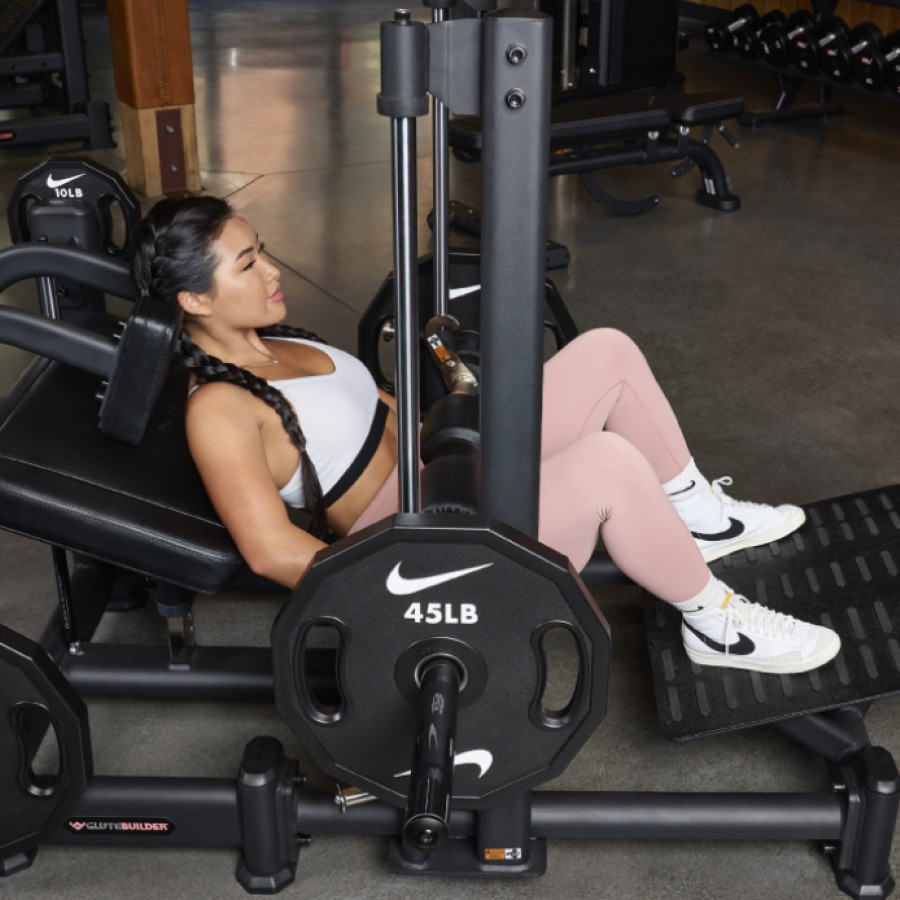
Glute Exercise #1: Hip Thrust
Equipment: Performed on the Hip Thrust Elite
(photo credit: Precor)
The weighted hip thrust is a fundamental glute exercise that targets all the muscles in the glutes and hips. This is a safer movement than squats or deadlifts because the location of the bar protects your lower back. The advantage with the Hip Thrust Elite machine is that the back and shoulder rests are adjustable, the starting position of the barbell is adjustable, and the barbell moves smoothly with you both vertically and horizontally so it traces the natural arc of your movement.
Tips for getting the most out of hip thrusts:
- Get your starting position right. The bar should be centered low across your hips rather than up on your belly or lower across your thighs. Your feet should be positioned so they are directly below your knees when you reach the top of the movement.
- To begin the movement, engage your core, press through your heels, and focus on using your glutes to raise your hips until your body forms a straight line.
- Do not arch your back to raise your hips higher than level. This doesn’t provide additional benefit and can lead to injury.
- Control the descent back to the starting position rather than letting the barbell drop suddenly. The eccentric contraction (i.e., muscle under tension as it lengthens) is a valuable part of the exercise.
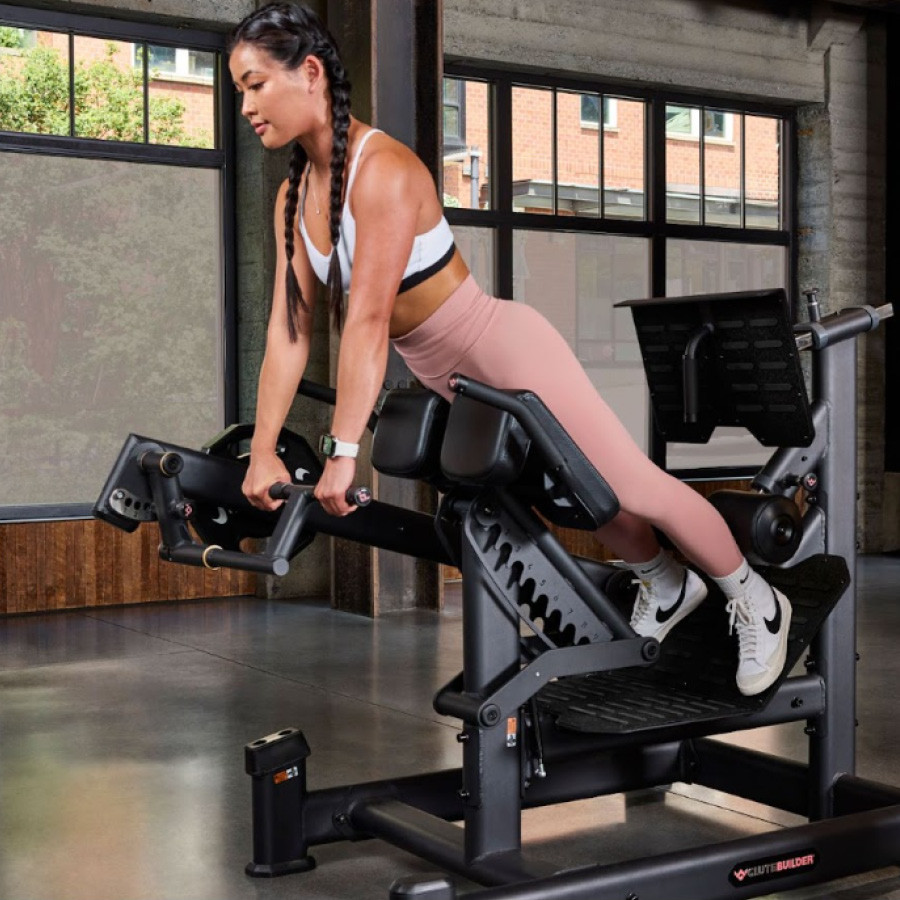
Glute Exercise #2: 45-Degree Glute Focused Hyperextension
Equipment: Performed on the Dual 45 Hip Extension
(photo credit: Precor)
The reason this is called a “45-degree glute focused hyperextension” is because variations of this exercise can target the muscles of the lower back. To focus this movement on your glutes, it’s important to start the movement by rounding your back and positioning your feet at about 45-degree angles (toes pointing out). You don’t need a ton of weight for this exercise. Rather, the benefit comes from first hinging at the waist and lengthening your glute muscles as you lower your shoulders to the starting position. This puts your glutes under immediate tension in a lengthened position as you start the upward extension.
Tips for getting the most out of hyperextensions:
- You should be able to feel that you’re contracting your glutes as you raise your body to a straight line from shoulders to heels. If you feel this exercise more in your hamstrings or in the muscles of your low to mid back, check your foot position and focus your mind on contracting primarily your glutes.
- Foot position is key. If your feet are straight, this exercise will likely target your hamstrings more than your glutes. The 45-degree toes-out foot position is important.
- You don’t need to use a lot of additional weight during this exercise. It will naturally be a less powerful movement than the hip thrust, and beginners may want to use body weight only.
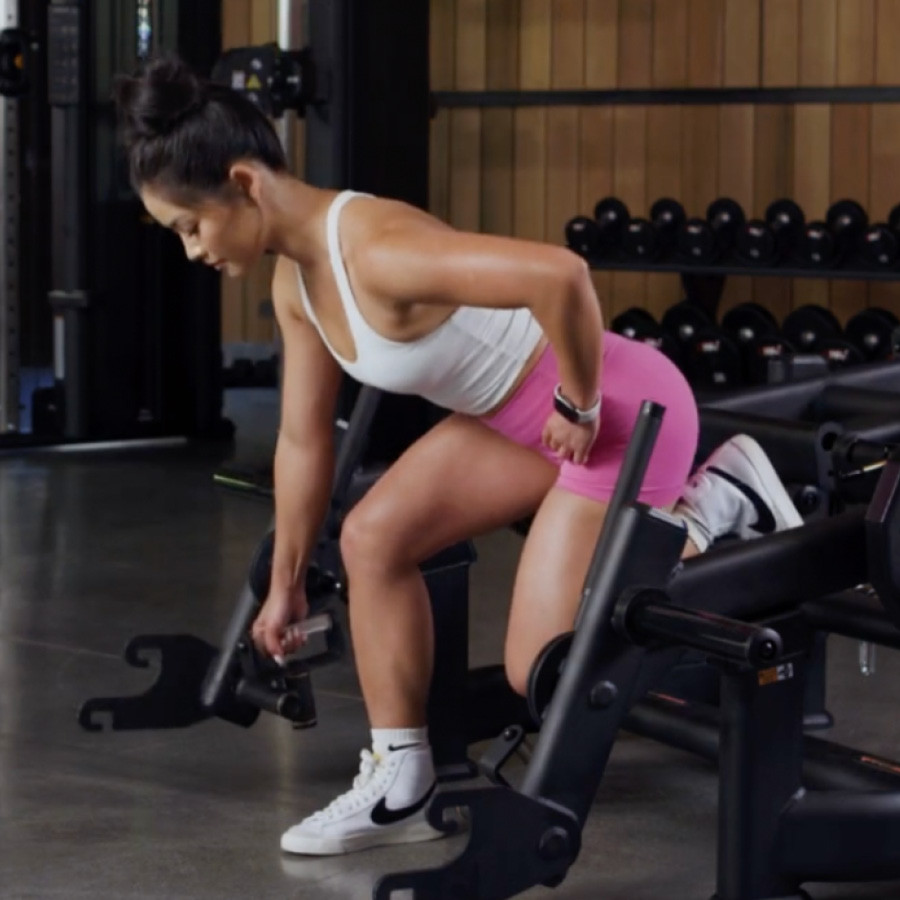
Glute Exercise #3: Bulgarian split squat with forward torso lean
Equipment: performed on the Deadlift Elite
(photo credit: Precor)
Bulgarian split squats are a great single-leg or one-sided movement that builds glute strength, but its even greater value comes from promoting hip stability. To perform this exercise well, you need to focus on keeping your hips level throughout the entire movement, rather than letting your hips dip to the less supported side.
Tips for getting the most out of Bulgarian Split Squats:
- By leaning your upper body forward and moving your front foot forward to lengthen your stance, you change the focus of this exercise from the quadriceps to the glutes.
- You can further focus this exercise on the glute medius muscle by widening your stance, but only widen your stance so your feet are about shoulder-width apart.
- You’ll likely start out stronger on one leg than the other. A good goal, over time, is to try to narrow or eliminate the imbalance between your two sides.
Biggest Takeaway: Ask a Trainer!
The Glute Zone is such an incredible feature in our facilities and there are so many ways we can help you get the most out of it. Whether you’re trying to mitigate lower back pain, achieve a shape or aesthetic you’ve been dreaming about, perform at your best in a specific sport, or be more functionally fit for everyday life, The Glute Zone is the place to work out. Several pieces of Precor equipment can be used to perform exercises you’ve done with other equipment in the past, and my colleagues and I would be thrilled to show you how to adapt your favorite movements to this new equipment!

Stephen Chacon is the Personal Training Manager
at Del Norte Sports & Wellness
Ready to feel it for yourself?
Strength isn’t just for athletes – it’s foundational for everyday life.
Explore how expert trainers can personalize your fitness journey.